

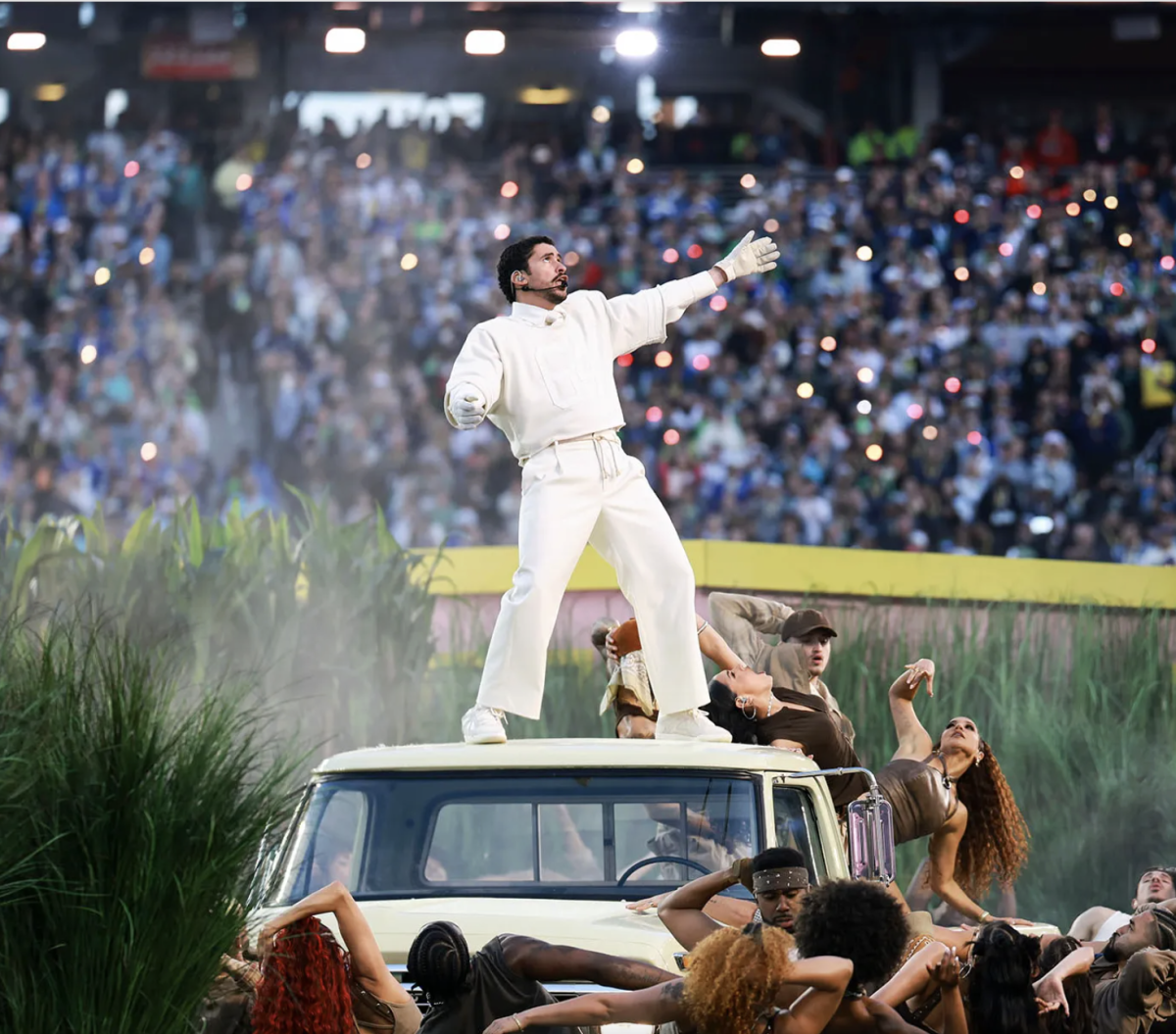
On Jan. 8, the Seattle Seahawks dominated the New England Patriots and won Superbowl LX by a margin of 29-13. While the game captivated many around the world, it was the halftime show that has left an imprint on most people’s minds. Puerto Rican artist Bad Bunny, also known as Benito Antonio Martínez Ocasio, performed alongside singers Lady Gaga and Ricky Martin. The performance was filled with joyful singing and dancing, as Bad Bunny embraced the political and historical aspects of his heritage.
The performance began with a set filled with long stalks of sugar cane, Puerto Rico’s cash crop. The stalks symbolized the extensive forms of slave labor and industrial production in the country throughout the 1800s. This was followed by several of Bad Bunny’s hits including “Tití Me Preguntó,” “Yo Perreo Sola,” “Safaera” and “Party.”
Throughout each song, the performance showcased elements of family, love, and Latin American heritage, depicting children dancing, a replica of a traditional Puerto Rican home, and workers on utility poles. The performance concluded with a unified depiction of what “America” is. Bad Bunny listed off nations from North, Central, and South America as he and his background dancers were seen carrying the flags belonging to those nations, including both the Puerto Rican and American flags.
He then walked onto the set in the middle of Levi’s Stadium in Santa Clara, California, and handed a Grammy trophy to a young boy who was meant to symbolize him as a child. In the background, a clip of Bad Bunny’s Grammy speech played on a TV set.
Just over a week ago, Bad Bunny was awarded album of the year at the Grammys for his album Debí Tirar Más Fotos. During his speech, he denounced U.S Immigrations and Customs Enforcement (ICE), declaring: “ICE out.” Bad Bunny holds Spotify’s Top Global Artist spot with over 19.8 billion streams.
Despite the large crowd that tuned in for the halftime performance, Turning Point USA, a nonprofit organization which advocates for conservative politics, was strongly against watching a Spanish speaker on the big screen; so they introduced an alternative halftime show starring American singer and songwriter Kid Rock.
Although both shows were aired at the same time, Bad Bunny delivered the most watched halftime show, reaching over 135 million views globally, while Kid Rock received only five million.
Bad Bunny’s voice was heard all over the world, including at Meridian.
“While I didn’t understand what he was saying most of the time, I really enjoyed it because I thought that the message was really clear,” said sophomore Aubrey Marrow.“When you say “America”, it’s not just the U.S.A, it’s North America and South America. Everyone said ‘It needs to be an American Superbowl’, and it was.”
Many fans in particular enjoyed the messaging behind the performance.
“I really liked the Super Bowl halftime show with all the amazing set design and songs. As a Bad Bunny fan, I loved the statement it made, especially about the blackouts in Puerto Rico with his song El Apagón,” said senior McKenna Gould. “I love how he showed people Spanish culture, the family, the love, and not the scapegoat rhetoric of immigrants being trouble.”
Others were slightly more critical, but they still appreciated the effort put into the performance.
“As a hispanic, I love how [Bad Bunny] represented us, although I think he was inexperienced because he was breathing really hard during the performance,” sophomore Aaliyah Guerra explained. “I really like the set and how he spread his Puerto Rican culture.”
However, while many students enjoyed Bad Bunny’s performance, a couple students watched the “All-American” alternative halftime show with Kid Rock.
“My parents were a little unhappy and they watched the alternative halftime show,” described another anonymous student.
The show also received criticism from the White House. President Donald Trump issued a statement just minutes after the performance, commenting “No one understands a word this guy is saying,” and “it doesn’t represent our standards of success, creativity, or excellence.”