

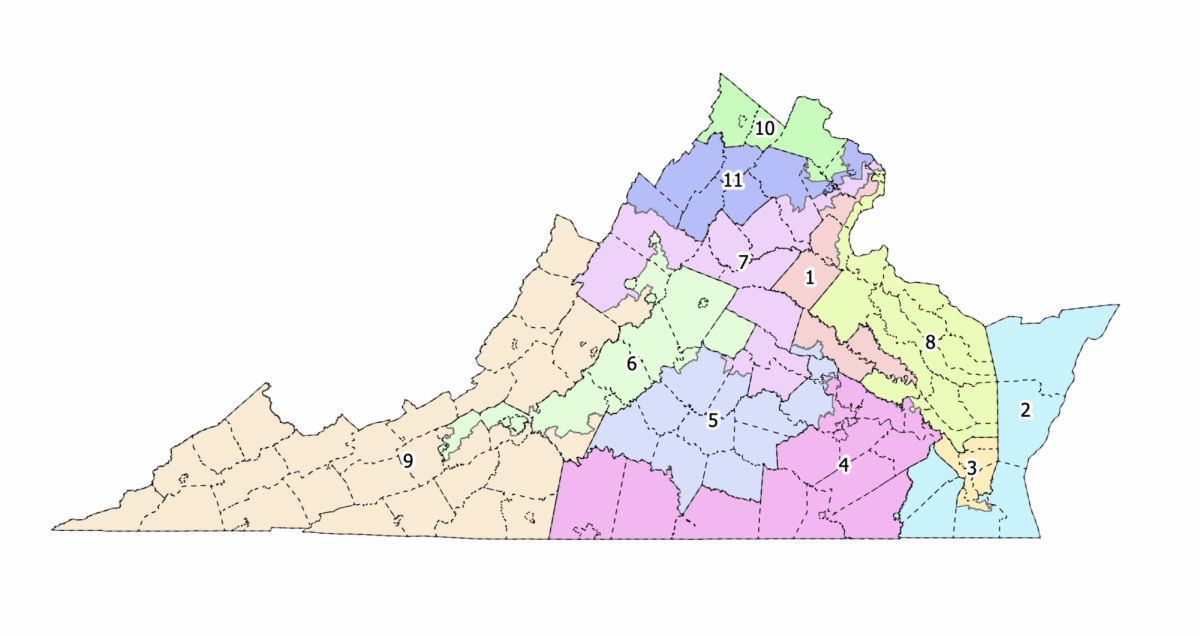
As the midterm elections approach, both political parties are trying to secure the majority for their party, which has involved unprecedented levels of gerrymandering. This is quite unusual, as gerrymandering generally occurs every 10 years during the census.
Gerrymandering is when politicians redraw congressional districts in a political party’s favor. Usually, all the Democratic or Republican areas will get shoved into one district and placed in districts with areas that favor the opposite party. This gives one party an advantage.
Multiple states have already redrawn districts in preparation for the midterms. States including Texas, North Carolina and Missouri have already done so in the Republicans’ favor. In response, California has gerrymandered in the Democrats’ favor, contributing five extra seats. Virginia is trying to do the same.
Virginia’s current district map favors the Democrats 6-5. On Feb. 5, a new map was released which favors Democrats 10-1.
However, Virginia law states that the district map can only be redrawn every ten years. An amendment to the Virginia Constitution is required to approve this new map. Last year, the Virginia General Assembly approved the new districts and started the process of creating a special election for voters to approve this map.
Virginian Republicans protested this change and brought the matter to court. A county circuit judge granted a temporary restraining order, saying that Virginian Democrats did not follow the correct process for creating an amendment. This stopped the voting process. In retaliation, Jay Jones, Virginia’s Attorney General said that his office would appeal the ruling to the Virginia Supreme Court.
On Mar. 4, the Virginia Supreme Court ruled that the special election could continue. Early voting began on Mar. 6 and election day is Apr. 21. However, the Virginia Supreme Court has not actually voted on whether the amendment is valid, just that the election could continue. After the vote happens, the court could still reject the amendment.
If the amendment is approved, all the congressional districts will be affected. The new map pushes the majority of Republican voters to one district, District 9. The rest are pushed into districts with a majority of Democrats.
Falls Church, is currently in the 8th District which contains most of Northern Virginia, including Arlington County and parts of Fairfax County.
Under the new map, Falls Church would be in the new District 7. District 7 will not have an incumbent and the current District 7 representative will be moved to District 1.
“We are sad to lose Representative Don Beyer,” Mayor Letty Hardi stated. Don Beyer has represented Falls Church since 2015.
This new map also affects voters in Fairfax and Arlington County. Fairfax is currently in the 10th, 11th and 8th districts but would be split into 5 districts, the 1st, 7th, 8th, 10th and 11th. Arlington is currently in the 8th district, but it would be split into the 8th and 7th districts.
The map will impact voters across Virginia especially in the Northern Virginia area, including Falls Church City.
“I think it would be okay if the District of Falls Church changed, just not as much as maybe we’re planning to do,” sophomore Vivienne Lam said.
Other students agreed and said that this process wasn’t a bad idea overall, especially considering the current political climate.
“The way our administration is handling things is not the best, so having a more balanced house would be better,” freshman Mia Helvin commented.
Overall, most Democratic Virginians and people in the Northern Virginia area think that this map is a good idea as it may balance out the House. However, Meridian will have to wait and see if the new map gets approved on Apr. 21.