

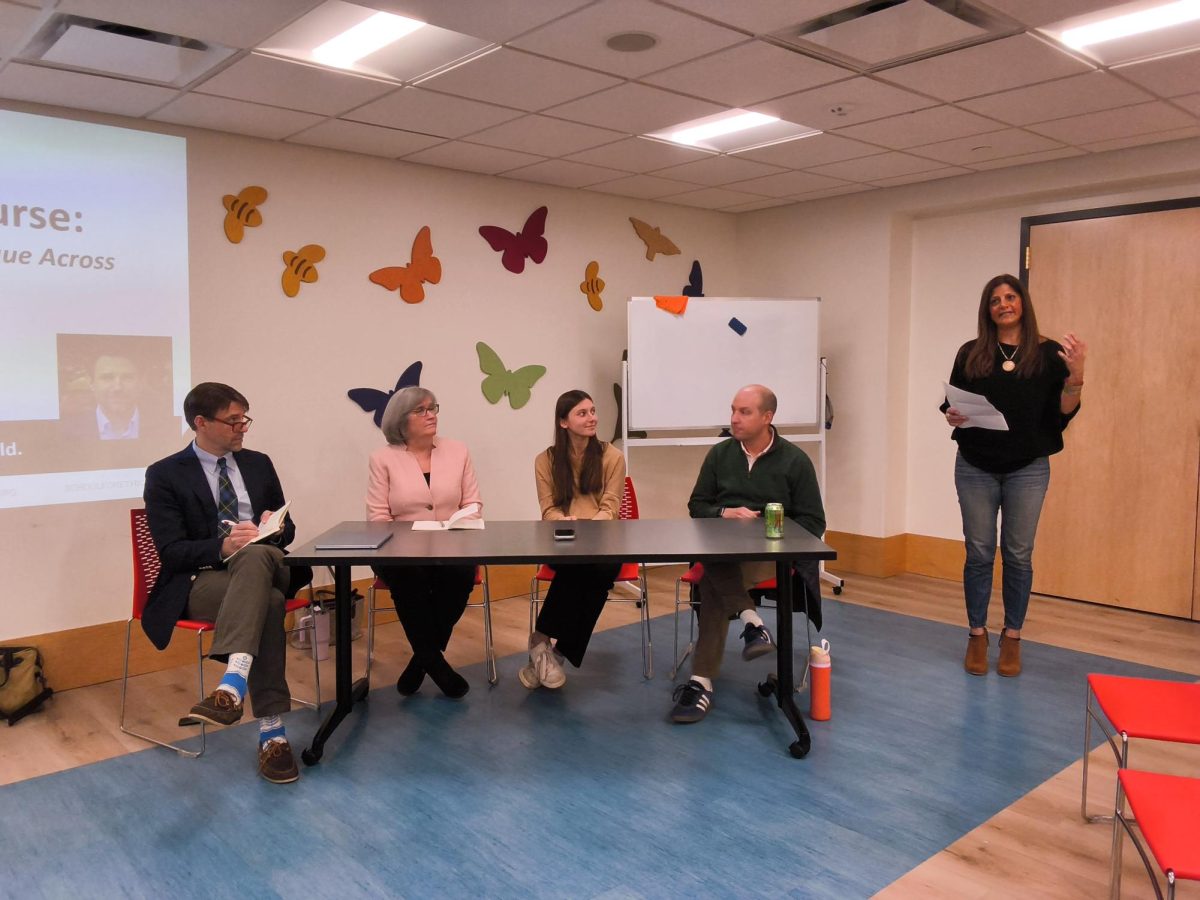
On Wednesday, March 18, the Falls Church-based organization We the Neighbors hosted an all-Falls-Church community conversation at Mary Riley Styles Library. The meeting, titled Dialogue Across Differences, focused on developing better communication through empathy and finding common ground between people with disagreements.
The panel featured Noah Bopp, the head of the School for Ethics and Global Leadership, Marybeth Connelly, a city council member, Meridian senior Cailyn Murphy and Jared Peet, a World History II and TOK teacher at Meridian.
Attending were numerous residents of the city, including private citizens, business owners, community leaders. Enough people were present to fill every available seat.
At the beginning of the conversation, the presenters had the audience spitball words that described U.S. political discourse in recent years. Attendees proposed “polarization”, “divisive”, “toxic”, “hot”, “chaotic” and “acrimonious” to describe the situation.
After the initial segment of audience participation, the presenters asked each other questions, which they answered using their own personal knowledge and experiences.
Peet agreed with the audience’s word selection, stating “I certainly do think we live in much more divisive times.”
However, he did not think that the gulf between those with differing views was unfordable. He recounted having been in Chile during the U.S. attacks on Venezuela in early January, being in a taxi driven by a Venezuelan immigrant who discussed his opinions on the situation. “I could actually talk to a Venezuelan and see [what they thought],” Peet said.
Council member Connelly agreed with Peet that empathy and understanding others’ points of view was key to extending understanding over differences in opinion.
She explained that, when dealing with uncooperative members of city council, “My strategy has been to be really super super super kind,” engaging with them on their terms.
Bopp followed up on that point, describing how he lived on the “friendliest street in D.C.” He attributed this to the fact that,despite their political disagreements, his wife would still bake cookies each year for their neighbor, the chief of staff for a Republican senator. The action allowed the neighbors to form community and trust.
Similarly, senior Cailyn Murphy thought that artificial discord was a major detriment to positive interaction in the present day, criticizing social media algorithms for driving conflict.
Earlier, Peet commented on the difficulty of attaining pure objectivity in discussion, opining that “As a history teacher, finding facts that we can all agree on is really difficult.”
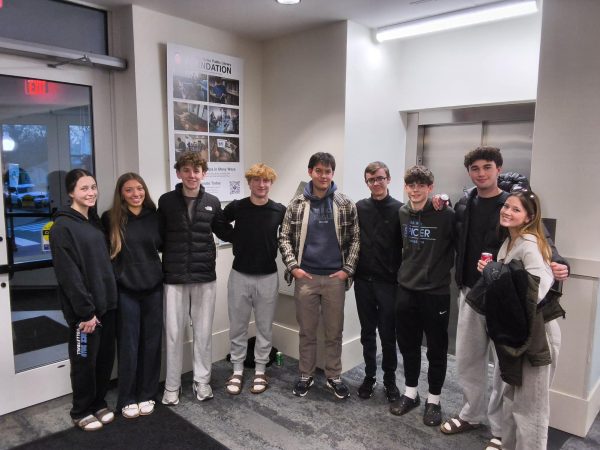
During the audience questioning period, Meridian junior Andrew Johnson ruminated on. Peet’s earlier statement. He reflected that, in the debate club, he would see people focus on the facts during competitions, but lose regardless.
He came to the conclusion that the pure facts often mattered less in communication than empathy, saying that “discussion is always a lot more subjective than we realize.”