


On Apr. 1, National Aeronautics and Space Administration (NASA) stunned the nation by launching Artemis II, a record-breaking spacecraft designed to loop around the moon. The 10 day mission launched from the Kennedy Space Center in Florida.
The Artemis II mission aims to provide data for the Artemis III mission, which hopes to land the first woman and first person of color on the Moon and is currently targeted for 2027. However, the launch of Artemis II was spectacular in its own right and is anticipated to break several records.
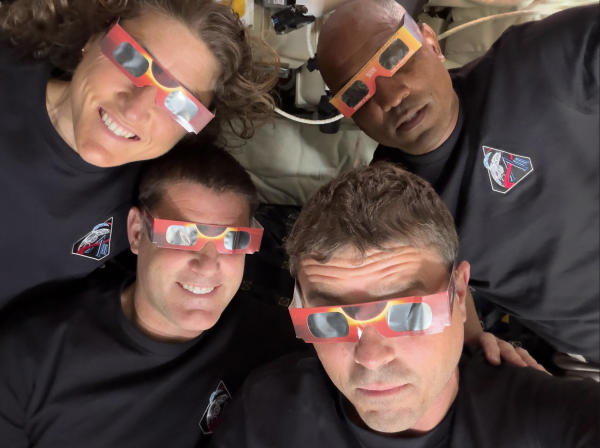
The crew consisted of four astronauts leading the expedition. According to Al Jazeera, Commander Reid Wiseman led the mission, who had served as a flight engineer on the international space station. Victor Glover piloted the mission with his experience being a U.S Navy Pilot. Mission Specialist Christina Koch previously shattered the record for having the longest single spaceflight by a woman at 328 days. Finally, former fighter pilot Jeremy Hansen is the first Canadian to travel to the moon.
Artemis II eclipsed record after record in space exploration, surpassing Apollo 13 by traveling farther from earth than any human ever had. The mission travelled 406,788 km from earth, while Apollo 13 only journeyed 400,171 km away.
The mission continued to generate intense interest even after takeoff. The crew was the first to witness parts of the moon’s far side with the naked eye. Artemis II has consistently sent back breathtaking photos of solar eclipses, up-close images of the lunar surface and even a couple humorous selfies of the crew themselves.
Although the mission was clearly electrifying for deep-space scientists at NASA, would the average high schooler share the same excitement?
“It’s historic,” junior Luke Flinter said. “We went further than any human has ever gone, and it is the most powerful rocket ever powered. I think it’s a great achievement for humanity.”
Similarly, other students seemed to know a fair amount about the launch.
“I think it was really cool because people haven’t been to the moon for decades,” freshman Isa George commented.
Some students had gone as far to follow the launch and keep up with the journey in real time.
“I know the astronauts were not very happy when President Trump called,” sophomore Ainsley Malloy recalled. “I saw a video where Trump was calling them and they were all floating there in silence.”
Artemis II has captured the attention of many, not only experts in the world of space exploration, but also to ordinary high schoolers across the nation. After the safe landing of Artemis II, NASA hopes to progress in their missions.
NASA Administrator Jared Isaacman made a statement that declared: “With Artemis II complete, focus now turns confidently toward assembling Artemis III and preparing to return to the lunar surface, build the base, and never give up on the Moon again.”