

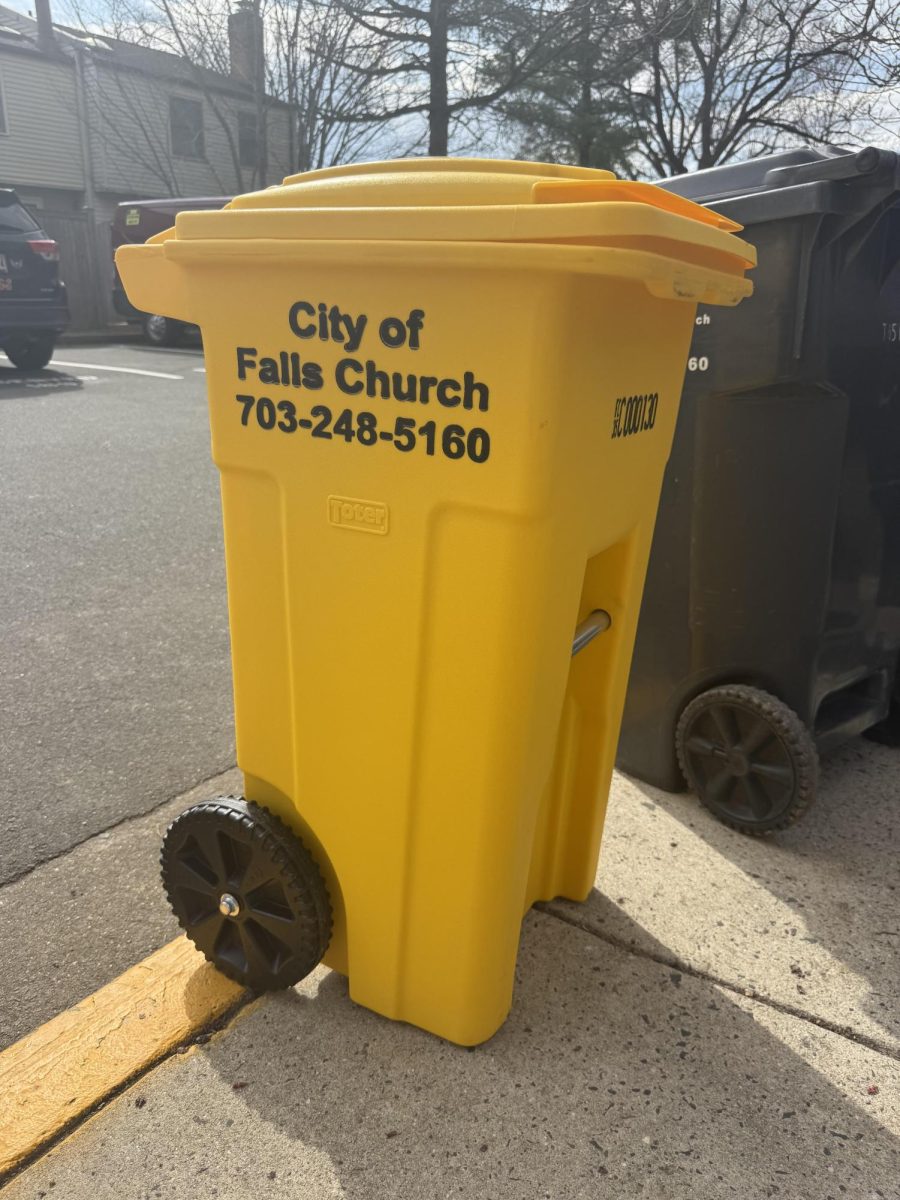
Starting on Mar. 2nd, Falls Church City began delivering Yellow Organic Carts to people who ordered them. These efforts aim to give residents the ability to compost both yard waste and food waste, with the goal of redirecting what goes into the incinerators.
The United States sends more food waste to landfills than any other material, and methane is produced when food breaks down at these landfill sites. Methane is a greenhouse gas, and is more than 20 times stronger than carbon dioxide. Since landfills aren’t made to keep methane in, it enters the atmosphere instead.
Most composting companies only accept yard waste, not food waste. However, this is changing in several cities. In Falls Church, the Organics Collection Program is allowing both food and yard waste to be composted.
Falls Church was the first city in Virginia to start curbside food waste composting, however some residents don’t love the bins for aesthetic reasons.
“I think that the yellow composting bins are important, but I don’t think that the yellow color is the way to go,” freshman Lily Young explained.
Another reason that students don’t like the composting bins is because their size is similar to normal bins.
“The bins are way too big because the ratio of trash and recycling to composting has a significant difference. There is more trash and recycling, so having another big bin that won’t be filled up all the way is pointless,” freshman Gabby Pizzirusso stated.
However, other students do enjoy the concept of composting, and they appreciate the city’s efforts.
“I think composting is great because it gives waste an opportunity to be given a new purpose,” junior Sienna Dawson remarked.
The collection service for the Yellow Organics Carts officially began March 11th. Items that can go into the carts are perishables like fruits and vegetables, grains, bread, pasta, eggshells, meat, coffee grounds and filters, pizza poxes, leaves or grass clippings, twigs, etc.
However residents are advised to avoid putting a variety of items into the bins, including glass bottles or jars, plastic bags or wrappers, paint, chemicals, batteries, electronics, grease, oils, fatty foods, etc.
This initiative is still in its youth but there are hopes that it can have a noticeable impact on our Little City and motivate the community to help protect the environment.